


Proper heating, ventilation, and air conditioning design is critical, given these systems account for 40-60% of a building’s total energy use. This comprehensive guide explores advanced engineering principles for rooftop unit (RTU) selection, load calculations, and air distribution systems. By mastering these elements, professionals can ensure efficient system operation, optimal indoor air quality, and strict compliance with building codes. From navigating complex utility and structural coordination to executing precise air balancing for positive and negative pressure zones, this resource provides actionable insights for accurate HVAC specification.
Precise load calculations for optimal sizing
Accurate HVAC load calculations determine the exact heating and cooling capacity a building requires. Engineers must meticulously calculate and aggregate all sources of heat gain to determine the total cooling load.
Key sources of heat gain include:
- Heat transfer: Occurs through walls and the roof.
- Solar heat gain: Enters directly through windows.
- Occupant load: Accounts for latent and sensible heat generated by people.
- Equipment and lighting: Heat dissipates from lighting systems and electrical/mechanical equipment.
- Ventilation and infiltration: Includes fresh outdoor air and uncontrolled leakage through gaps.
A properly designed system must eliminate both sensible load (heat that increases air temperature) and latent load (heat that increases moisture content). Failure to control humidity leads to occupant discomfort, even at lower temperatures. For precise modeling, professionals typically rely on industry-standard software tools such as Carrier HAP or TRACE 700.
Determining precise ventilation requirements
HVAC systems must supply controlled amounts of fresh outdoor air to dilute indoor pollutants, odors, and carbon dioxide. Well-designed ventilation can reduce indoor pollutant concentrations by up to 80%.
The Total CFM (Cubic Feet per Minute) of outside air is established by combining people-based and area-based calculations, governed by standards such as ASHRAE 62.1 and the Mechanical Building Code.
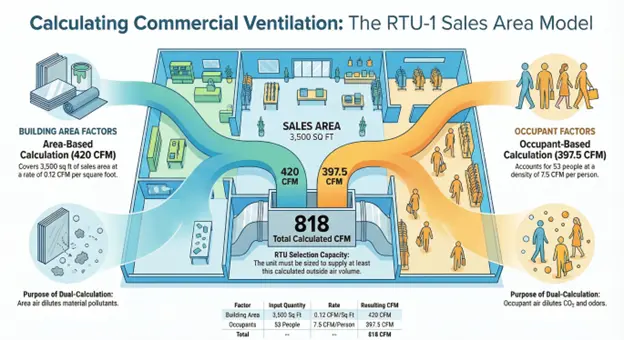
| MA RK | AREA SERVED | AREA (SQFT) | PEOPLE/ 1,000 (SQFT) | PEOPLE | CFM/ PERSON | PEOPLE OUTSIDE AIR (CFM) | CFM/ SQFT | AREA OUTSIDE AIR (CFM) | TOTAL CFM CALCULATED | CFM SUPPLIED |
| RTU-1(E) | SALES | 3500 | 15 | 53 | 7.5 | 397.5 | 0.12 | 420 | 818 | 820 |
Table 403.3.1.1
Based on Table 403.3.1.1, the calculation process is as follows:
- People-based calculation: Determines fresh air based on occupant density.
- Area-based calculation: Determines fresh air needed to dilute pollutants from building materials.
- Total CFM: The sum of both calculations dictates the final outside air requirement used for RTU selection.
Strategic RTU selection criteria
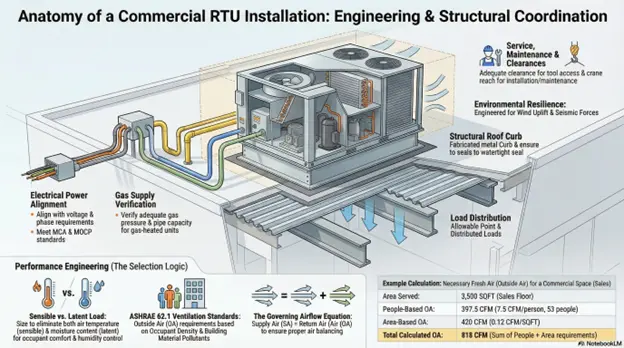
Selecting the appropriate RTU requires a rigorous evaluation of site conditions, client standards, and structural constraints.
- Client standards and project requirements: Confirm preferred manufacturers, efficiency levels, and required features such as economizers, demand-controlled ventilation, or smoke detectors.
- Site utility availability: Verify gas pressure, pipe capacity, and electrical infrastructure, ensuring the unit’s voltage, phase, and MCA/MOCP align with the building’s power supply.
- Structural coordination: Confirm allowable point and distributed loads with the structural team. Account for the total operating weight, wind uplift, and seismic requirements.
- Installation and maintenance: Ensure adequate service clearances, crane access, and compatibility with roof curbs.
While engineering defines these specifications, translating them into a coordinated construction environment is where many projects face friction. studio PARAMETRIC supports AEC firms by providing BIM services for Architecture and MEP, ensuring these complex HVAC systems are perfectly modeled and clash-free. If you need help bringing your HVAC designs into a high-fidelity BIM environment, you can explore our services here.
Engineering the air distribution system
Air terminals dictate how conditioned air is delivered into the occupied space. Selecting the right terminal is vital for proper airflow and indoor air quality optimization.
- Square/Round Diffusers: Spread air in a wide pattern along the ceiling to promote thorough mixing.
- Grilles and Registers: Grilles direct airflow in specific patterns, while registers include an integrated damper for volume control.
- Linear Slot Diffusers: Provide a narrow “sheet” of air, often used for aesthetic purposes or air curtains.
- Jet Nozzle Diffusers: Throw air over long distances, making them ideal for large atriums or warehouses.
- Round Swirl Diffusers: Introduce rapid rotation to the supply air, perfect for temperature equalization in high-ceiling spaces.
- Eggcrate Grilles: Offer very low airflow resistance, typically used for return or exhaust applications.
Air balancing and pressure control
Proper air balancing guarantees the correct amount of conditioned air reaches each room, preventing inconsistent temperatures and inefficient system operation. Overworked fans due to restricted airflow, such as from dirty filters, can increase energy consumption by up to 15%.
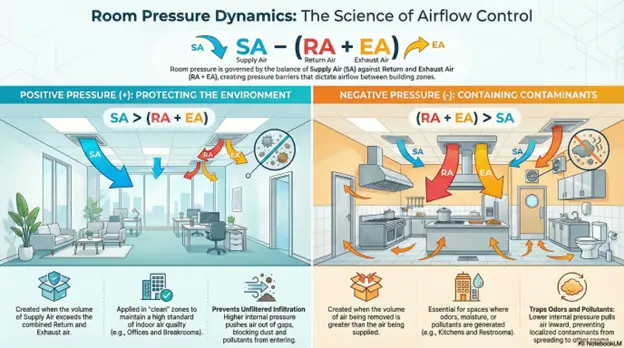
Space pressurization is dictated by the relationship between supply air (SA), return air (RA), exhaust air (EA), and outside air (OA). The governing equation for room pressure is $SA-(RA+EA)$.
- Positive pressure rooms: Occur when supply air exceeds the combined return and exhaust air. Used in offices and breakrooms to prevent unfiltered air from entering.
- Negative pressure rooms: Occur when more air is removed than supplied. Essential for kitchens and restrooms to trap odors and contaminants.
At the unit level, airflow must balance according to $SA=RA+OA$. Final verification is executed through Testing, Adjusting, and Balancing (TAB) procedures.
Air balance schedule
| MARK | SUPPLY AIR | RETURN AIR | OUTSIDE AIR | EXHAUST AIR | PRESSURE |
| RTU-1 | 4000 | 3800 | 200 | +200 | |
| RTU-2 | 3400 | 3075 | 325 | +325 | |
| RTU-3 | 3400 | 3070 | 320 | +320 | |
| EF-1 | -350 | -350 | |||
| EF-2 | -200 | -200 | |||
| TOTAL | +845 | -550 | +295 |
Conclusion
Mastering RTU selection and air distribution is an ongoing necessity for engineering high-performance commercial spaces. By moving beyond basic formulas and strictly applying load calculations, building code ventilation standards, and rigorous site coordination, AEC professionals can deliver systems that optimize both energy efficiency and occupant health. Precise air balancing further guarantees that the mechanical design functions exactly as intended in the real world. Integrating these advanced methodologies into your workflow not only mitigates project delays but establishes a higher benchmark for commercial building performance.