

Peter Drucker’s words resonate deeply in the world of architecture and construction, where the blueprint of tomorrow is drawn not just with ink and software but with immersive experiences (Drucker 2008). For centuries, architects relied on static drawings, then CAD (Computer-Aided Design) revolutionized drafting, and later, Building Information Modelling (BIM) turned blueprints into intelligent digital twins (Eastman et al. 2011). Yet, even with all this evolution, something was missing—the ability to truly experience a design before it became reality.
Enter Augmented Reality (AR) and Virtual Reality (VR), the twin titans reshaping the construction industry (Azhar 2011). No longer confined to screens, BIM has broken free, allowing architects to walk through their designs, engineers to inspect structures before they rise, and builders to see the invisible—turning ideas into lived experiences before the first stone is laid (Wang et al. 2013).
The Ghost in the Machine: Breathing Life into Blueprints
Once, an architect’s vision remained trapped in static diagrams—dreams captured in ink, waiting for translation into brick and mortar. BIM changed that, layering data over models, embedding materials, structures, and environmental variables into a single dynamic entity (Hardin and McCool 2015). Yet, it remained limited to digital screens, a ghost without a body.
Then came AR and VR, the alchemists that gave BIM its form in the real world (Chi et al. 2013). Suddenly, architects didn’t just look at their buildings; they walked through them. Engineers no longer relied on abstraction—they reached out and interacted with their designs. These technologies blurred the line between imagination and execution, ensuring that errors, inefficiencies, and miscalculations were caught long before they could manifest in reality (Li et al. 2018).
The Architect’s Crystal Ball: VR and Predictive Design
Imagine stepping into a space before it is even encompassed by walls, before the first stone is laid, feeling the vast emptiness, hearing the echoes of footsteps on future marble floors. VR offers architects and designers this gift—the ability to inhabit their creations before they exist (Whyte 2017). Every beam, column, archway, and slab can be scrutinized for its harmony, ensuring aesthetic and functional parameters are satisfied before breaking ground.
For urban planners, the stakes are even higher. Entire cities can be built in the virtual realm, allowing simulations of traffic flow, sunlight patterns, and pedestrian movement (Shirowzhan et al. 2020). Design is no longer a game of anticipation —it is a calculated orchestration of form and function, tested in a space where failure costs nothing and insight is infinite.
What Has Already Happened: Real-World Integration of AR/VR with BIM
The construction and infrastructure industry are undergoing a digital renaissance, led by the convergence of BIM, AR, and VR technologies (Azhar 2011). These tools are no longer experimental novelties—they are actively reshaping project workflows, design performance, decision-making, and stakeholder collaboration (Li et al. 2018).
a) Immersive VR for Client-Centric Design Review
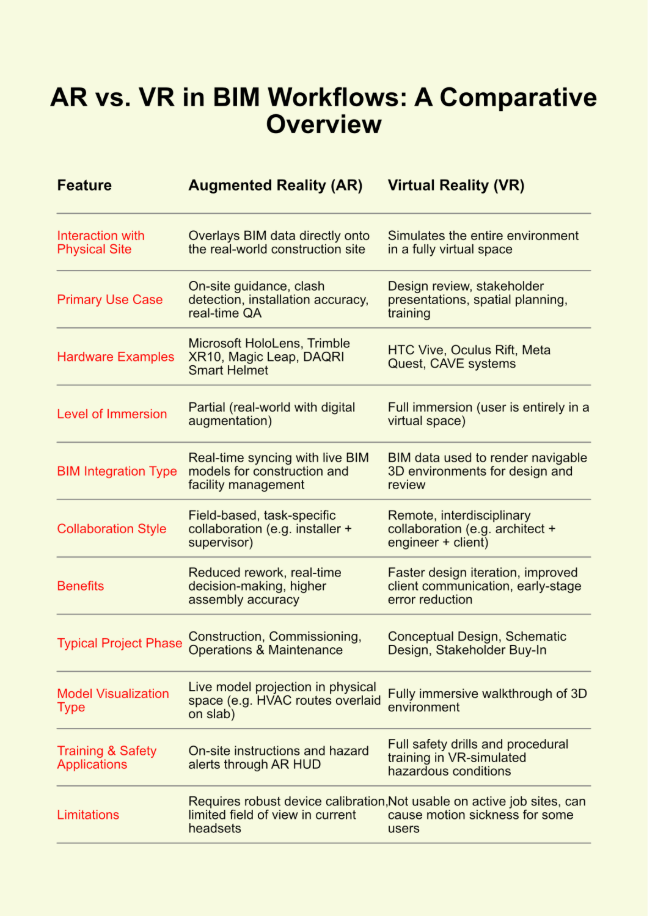
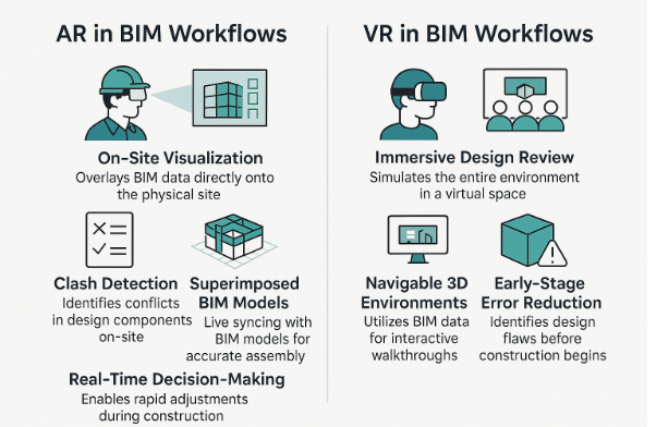
VR-integrated BIM environments were deployed by Foster + Partners to transform the way clients engage with proposed designs (Autodesk 2023). Rather than navigating static renders or complex CAD files, stakeholders can step inside a 1:1 scale VR simulation, experiencing spatial configurations, lighting conditions, and material textures before the first brick is laid. This immersive design review helps reduce redesigns, accelerates approvals, and aligns expectations across disciplines.
Technology stack: Unity3D-based VR engines linked with Autodesk Revit BIM models, allowing real-time updates and interaction during design evolution (Autodesk 2023).
b) AR Clash Detection and On-Site Visualization
Skanska and a few other contractors have taken AR out of the design room and into the field (Skanska 2022). By integrating AR overlays with BIM coordination models, their engineers and site managers can visualize MEP (Mechanical, Electrical, Plumbing) systems layered over physical spaces using devices like Trimble XR10 or tablets (Trimble 2022). This enables real-time clash detection, identifying spatial conflicts before physical components are installed.
Impact: Projects have reported up to 70% reduction in rework due to early identification of misalignments, saving both time and budget (Skanska 2022).
c) Trimble + Microsoft HoloLens – Mixed Reality for Assembly Accuracy
Through a collaboration with Microsoft, Trimble’s integration of HoloLens 2 with Trimble Connect for HoloLens allows construction teams to superimpose BIM data onto real-world conditions (Microsoft 2023). For example, a steel fabricator at a job site can “see” where beams should be welded or bolted without referring to 2D drawings. This real-time guidance enhances fabrication accuracy, especially in complex geometries.
Case Study: Mortenson Construction used HoloLens to reduce the installation time of electrical and piping components by 25%, while also boosting worker confidence and reducing QA/QC delays (Mortenson 2021).
d) International Transport Hubs – Simulating Passenger Flow Using VR
Designers of high-traffic infrastructure, such as Heathrow Terminal 5 and Doha’s Hamad International Airport, have employed VR simulations driven by BIM models to simulate and optimize passenger movement, identify choke points, and test evacuation scenarios (Heathrow 2019). These simulations, often backed by agent-based crowd modelling, ensure functional circulation and code compliance well before construction begins.
Result: Reduced post-construction retrofits and smoother commissioning processes.
Augmented Reality: The Precision Lens of Construction Execution
Unlike VR, which removes the user from the real world, AR enhances it (Chi et al. 2013). A field engineer, wearing AR glasses like Magic Leap or Microsoft HoloLens, can visualize piping systems, HVAC ducts, or conduit paths overlaid on the raw construction frame, directly synced with cloud-hosted BIM models (Microsoft 2023).
How AR Transforms Execution:
Real-Time Model Alignment: Workers can compare the physical build with the digital twin instantaneously.
Dynamic Progress Monitoring: Supervisors can perform on-site as-built vs. as-designed comparisons, catching discrepancies on the fly.
Instructional Overlays: Smart helmets display animated step-by-step instructions for complex installations, minimizing misinterpretation of technical drawings (Trimble 2022).
Example: Bechtel Construction uses AR headsets in nuclear facilities to visualize radiation shielding elements and ensure compliance with nuclear-grade tolerances, reducing inspection cycles by nearly 40% (Bechtel 2023).
What’s Next? Emerging Frontiers in BIM + AR/VR Integration
The current frontier is not about replacing human intelligence but amplifying it—and BIM sits at the core of this transformation (Succar 2009).
a) AI-Integrated AR for Predictive Maintenance
Future-ready AR devices, integrated with AI algorithms trained on structural health monitoring data, will identify material stress, thermal fatigue, or corrosion zones in real time (Dong and Kamat 2021). BIM models serve as the spatial reference system, allowing AR to pinpoint risk areas during inspections.
A use case: Smart AR glasses could guide a technician along a maintenance path while highlighting parts nearing end-of-life, tagged through IoT sensors embedded in the BIM ecosystem.
b) Blockchain + BIM for Real-Time Quality Verification
Imagine every bolt, weld, and component tracked immutably. By integrating blockchain technology with BIM, each construction activity is time-stamped, geotagged, and securely logged (Wang et al. 2020). AR overlays can then verify whether the installed components match the digital ledger.
Impact: Reduces discrepancies, streamlines audits, and strengthens legal accountability in mega-projects.
c) Cloud-Based VR Collaboration Across Continents
With tools like Autodesk BIM 360, NVIDIA Omniverse, and IrisVR, architects in India and structural consultants in Tokyo can walk through the same VR model simultaneously, leave annotations, simulate structural loads, or reconfigure elements—all within a shared immersive environment (Autodesk 2023).
Key Feature: Live changes update the central BIM repository in real-time, ensuring data consistency and collaborative synergy.
d) AR-Enabled Smart Helmets – Knowledge at Eye Level
Companies like DAQRI and Trimble have pioneered AR-powered hard hats that provide context-sensitive instructions (Trimble 2022). When a worker approaches an area, the helmet displays relevant BIM-derived schematics, QA checklists, or warnings.
Result: Dramatically reduces onboarding time for new workers and ensures high craftsmanship regardless of experience level.
Training the Next Master Builders
Once, master builders spent decades honing their craft under the watchful eyes of mentors. Today, that process is radically accelerated. VR training environments allow young engineers and architects to make mistakes without real-world consequences (Sacks et al. 2013). AR overlays guide on-site apprentices with real-time, step-by-step instructions, turning construction sites into classrooms where mastery is no longer a matter of years but of immersive learning.
Through VR, a trainee can practice assembling complex machinery an infinite number of times without wasting real materials. Through AR, every task is guided with holographic precision, reducing errors and ensuring that every worker is an expert in real-time (Trimble 2022).
Sustainability and the Virtual Sandbox
Sustainability is no longer optional—it is imperative. Yet, predicting the environmental impact of a structure has often been a game of best guesses. AR and VR are changing that. Before a single tree is felled, designers can simulate wind patterns, heat flow, and energy efficiency, ensuring that buildings coexist harmoniously with their environment (Kensek 2014).
Material choices, energy consumption, and waste reduction strategies can be optimized in a risk-free, virtual space. The future of construction is not just intelligent—it is profoundly responsible.
The Dawn of a New Reality
BIM was the first revolution, a grand awakening of the construction industry to the power of data (Eastman et al. 2011). AR and VR are the next leap forward, breaking BIM out of screens and into the realm of lived experience (Azhar 2011). The days of static blueprints are numbered; the future belongs to those who can walk through their creations before they exist.
In this brave new world, construction sites glow with AR projections, boardrooms echo with the silent awe of VR walkthroughs, and the boundaries between imagination and execution dissolve. The future of BIM is no longer just about data—it is about immersion, experience, and transformation.
References:
Autodesk. 2023. Autodesk Revit: BIM Software for Designers, Builders, and Doers. Accessed April 21, 2025. https://www.autodesk.com/products/revit/overview.
Azhar, Salman. 2011. “Building Information Modeling (BIM): Trends, Benefits, Risks, and Challenges for the AEC Industry.” Leadership and Management in Engineering 11, no. 3: 241–252. https://doi.org/10.1061/(ASCE)LM.1943-5630.0000127.
Bechtel. 2023. “Innovating Nuclear Construction with AR Technology.” Bechtel Corporate Newsroom. Accessed April 21, 2025. https://www.bechtel.com/newsroom/.
Chi, Hung-Lin, Shih-Chung Kang, and Xiangyu Wang. 2013. “Research Trends and Opportunities of Augmented Reality Applications in Architecture, Engineering, and Construction.” Automation in Construction 33: 116–122. https://doi.org/10.1016/j.autcon.2012.12.017.
Dong, Anping, and Vineet R. Kamat. 2021. “Artificial Intelligence in Construction: Applications and Future Directions.” Journal of Construction Engineering and Management 147, no. 8: 03121001. https://doi.org/10.1061/(ASCE)CO.1943-7862.0002108.
Drucker, Peter F. 2008. The Essential Drucker: The Best of Sixty Years of Peter Drucker’s Essential Writings on Management. New York: Harper Business.
Eastman, Chuck, Paul Teicholz, Rafael Sacks, and Kathleen Liston. 2011. BIM Handbook: A Guide to Building Information Modeling for Owners, Managers, Designers, Engineers and Contractors. 2nd ed. Hoboken, NJ: Wiley.
Hardin, Brad, and Dave McCool. 2015. BIM and Construction Management: Proven Tools, Methods, and Workflows. 2nd ed. Indianapolis, IN: Sybex.
Heathrow. 2019. “Heathrow Terminal 5: A Case Study in VR-Driven Design.” Heathrow Airport Archives. Accessed April 21, 2025. https://www.heathrow.com/company/about-heathrow/history.
Kensek, Karen M. 2014. Building Information Modeling. London: Routledge.
Li, Xiang, Peng Wu, Geoffrey Qiping Shen, Xiangyu Wang, and Yong Teng. 2018. “Mapping the Knowledge Domains of Building Information Modeling (BIM): A Bibliometric Approach.” Automation in Construction 84: 195–206. https://doi.org/10.1016/j.autcon.2017.09.011.
Microsoft. 2023. “HoloLens 2: Mixed Reality in Construction.” Microsoft Industry Blogs. Accessed April 21, 2025. https://www.microsoft.com/en-us/hololens/industry-construction.
Mortenson. 2021. “Case Study: HoloLens in Construction Efficiency.” Mortenson Innovation Reports. Accessed April 21, 2025. https://www.mortenson.com/innovation.
Sacks, Rafael, Chuck Eastman, and Ghang Lee. 2013. “Virtual Reality and Training for Construction Safety and Efficiency.” Journal of Computing in Civil Engineering 27, no. 2: 133–142. https://doi.org/10.1061/(ASCE)CP.1943-5487.0000198.
Shirowzhan, Sara, Samad M. E. Sepasgozar, and John C. Trinder. 2020. “Smart Cities and Virtual Reality: A Review of Applications and Challenges.” Sustainable Cities and Society 61: 102346. https://doi.org/10.1016/j.scs.2020.102346.
Skanska. 2022. “AR in Construction: Enhancing On-Site Precision.” Skanska Technology Updates. Accessed April 21, 2025. https://www.skanska.com/innovation/.
Succar, Bilal. 2009. “Building Information Modelling Framework: A Research and Delivery Foundation for Industry Stakeholders.” Automation in Construction 18, no. 3: 357–375. https://doi.org/10.1016/j.autcon.2008.10.003.
Trimble. 2022. “Trimble XR10: Augmented Reality for Construction.” Trimble Construction Solutions. Accessed April 21, 2025. https://www.trimble.com/en/solutions/construction.
Wang, Jun, Xiangyu Wang, and Lei Hou. 2020. “Blockchain-Based BIM for Construction Quality Assurance.” Automation in Construction 112: 103092. https://doi.org/10.1016/j.autcon.2020.103092.
Wang, Xiangyu, Peter E. D. Love, Mi Jeong Kim, and Chun Sang Park. 2013. “Augmented Reality and Virtual Reality in Construction: A Review.” Visualization in Engineering 1, no. 1: 3. https://doi.org/10.1186/2213-7459-1-3.
Whyte, Jennifer. 2017. Virtual Reality and the Built Environment. 2nd ed. London: Routledge.