

Choosing software for highway engineering is a big deal for any design firm. This choice changes how your people work together every day. It decides how you handle giant files and which contracts your company can actually win.
In this business, people always debate about Autodesk Civil 3D versus Bentley OpenRoads Designer. But many engineers miss the real point. The best tool for you is not just about a list of features; it is a choice between two different philosophies—and one of them fits the way most firms actually work.
People who work in the trenches put it plainly: Civil 3D is a mature, versatile platform built around real-world plan production with powerful 3D modeling on top. OpenRoads, by contrast, is a heavy 3D modeling environment that can produce plans, but often at the cost of steep learning curves and rigid workflows.
When we talk to clients, we tell them that picking between these two options is not like choosing a brand of truck. It is more like choosing between a reliable, well-supported fleet vehicle that most drivers already know how to operate versus a specialized machine that takes months to master.
File Formats and Stability
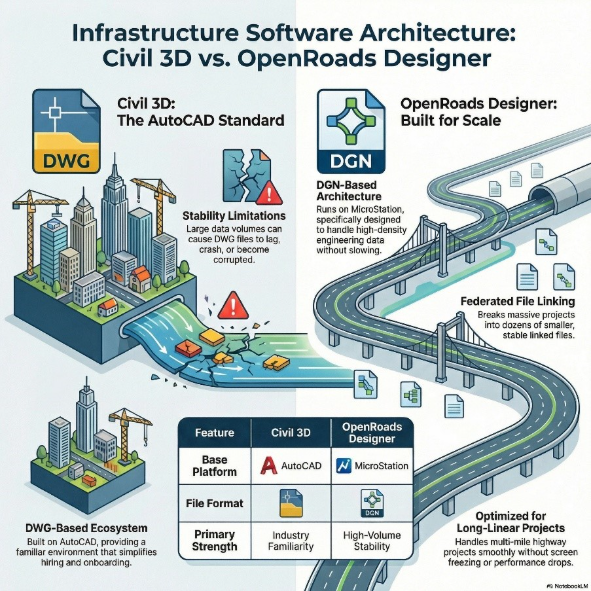
The first big difference starts with the file format:
Civil 3D:
- Built on AutoCAD and uses DWG files, which are the most recognized and widely supported format in the industry.
- Nearly every engineer, drafter, and contractor is already familiar with DWG.
- This familiarity makes onboarding fast, collaboration easy, and file sharing painless across the entire project team.
- While very large, data-heavy files can slow down the system, experienced firms manage this easily through:
- Good file referencing practices
- The use of data shortcuts
Bentley OpenRoads Designer:
- Runs on MicroStation and uses the DGN format.
- DGN handles large datasets by breaking projects into many linked files, which adds significant complexity.
- Managing dozens of interconnected files requires:
- A disciplined workflow
- Deep platform knowledge
For many firms, this overhead introduces more risk than it removes.
How the Highway Logic Works
Civil 3D utilizes “Assemblies,” a flexible and intuitive system that allows users to snap components together to create road cross-sections. This method is easy to understand, quick to learn, and can accommodate everything from urban streets to complex interchange designs. A skilled Civil 3D team can efficiently build and modify corridor models, and with a vast library of community-created subassemblies, solutions are often just a download away.
OpenRoads Designer utilizes math-based “Templates” that are more rigid and take considerably longer to create from scratch. Although these templates can automatically update when designs change, the initial time investment required to set them up correctly is substantial. As a result, teams often spend weeks building the workspace before any actual design work can begin—time that Civil 3D users typically spend delivering results.
Handling Large Data Sets
Civil 3D’s TIN surface engine is ideal for detailed, site-level work, which constitutes the majority of infrastructure projects. For longer corridors or extensive LiDAR datasets, experienced teams employ surface management techniques—such as splitting surfaces or using point cloud references—to maintain strong performance. These techniques are well-documented and widely understood.
On the other hand, OpenRoads is better equipped to handle very large terrain datasets and point clouds with greater ease. Its integration with ProjectWise also facilitates multi-user collaboration on large projects. However, these advantages come with Bentley’s complex licensing and infrastructure requirements, which can pose a significant challenge for mid-sized firms.
What the Clients Want
The market tells the real story and highlights the following key points:
Dominance of Civil 3D
Civil 3D is a leader in the private sector, especially in areas such as:
- Land development
- Urban roads
- Site grading
- Municipal projects
- Commercial work
These sectors account for the majority of billable work for most design firms.
Talent Pool:
- Civil 3D is taught at nearly every university, leading to a deep talent pool.
- Firms can hire new graduates and have them productive within weeks.
Role of OpenRoads:
OpenRoads is required for certain state Department of Transportation (DOT) contracts, and firms seeking large federal highway projects must demonstrate proficiency with it.
However, OpenRoads presents several challenges:
- Difficulty in staffing
- High maintenance costs
- Long training periods
Strategic Investment:
- For firms aiming to compete for DOT work, investing in OpenRoads is essential.
- It should be considered a specialized capability rather than a direct replacement for Civil 3D.
This clearer structure allows for easier understanding of the differences and requirements for firms in the civil engineering sector.
Automation and Out-of-the-Box Tools
Civil 3D’s greatest strength lies in its extensive ecosystem. With tools like Dynamo, the App Store, thousands of community-created scripts, and decades of shared knowledge, there’s a proven solution available for nearly any workflow challenge. If your team encounters a problem, help is just a forum search away.
In contrast, OpenRoads relies heavily on its internal logic engine, which requires firms to manage a complex Bentley workspace in-house. While this approach reduces dependence on third-party scripts, it places a significant burden on the need for internal expertise. In today’s hiring market, finding and retaining staff who are truly proficient in OpenRoads is a considerable challenge.
Pick the Right Engine for Your Scale
For most firms, Civil 3D is the clear choice. It is quicker to learn, easier to staff, better supported by the industry, and suitable for a wide range of projects. Its flexibility, community support, and deep integration with the broader Autodesk platform make it the go-to tool for modern infrastructure design.
OpenRoads Designer, on the other hand, is a strong option for firms focused on large-scale state highway projects, but it is a specialized tool that comes with specific requirements. Overall, Civil 3D effectively meets a variety of needs and performs exceptionally well.
At studio PARAMETRIC, our team is highly proficient in Autodesk Civil 3D and Bentley OpenRoads Designer, enabling us to adapt to client preferences, compliance requirements, and project scale without compromise.
With strong hands-on experience and structured workflows, we help our clients navigate complexity and deliver infrastructure projects with confidence.